The laughs are free. The work is daily.
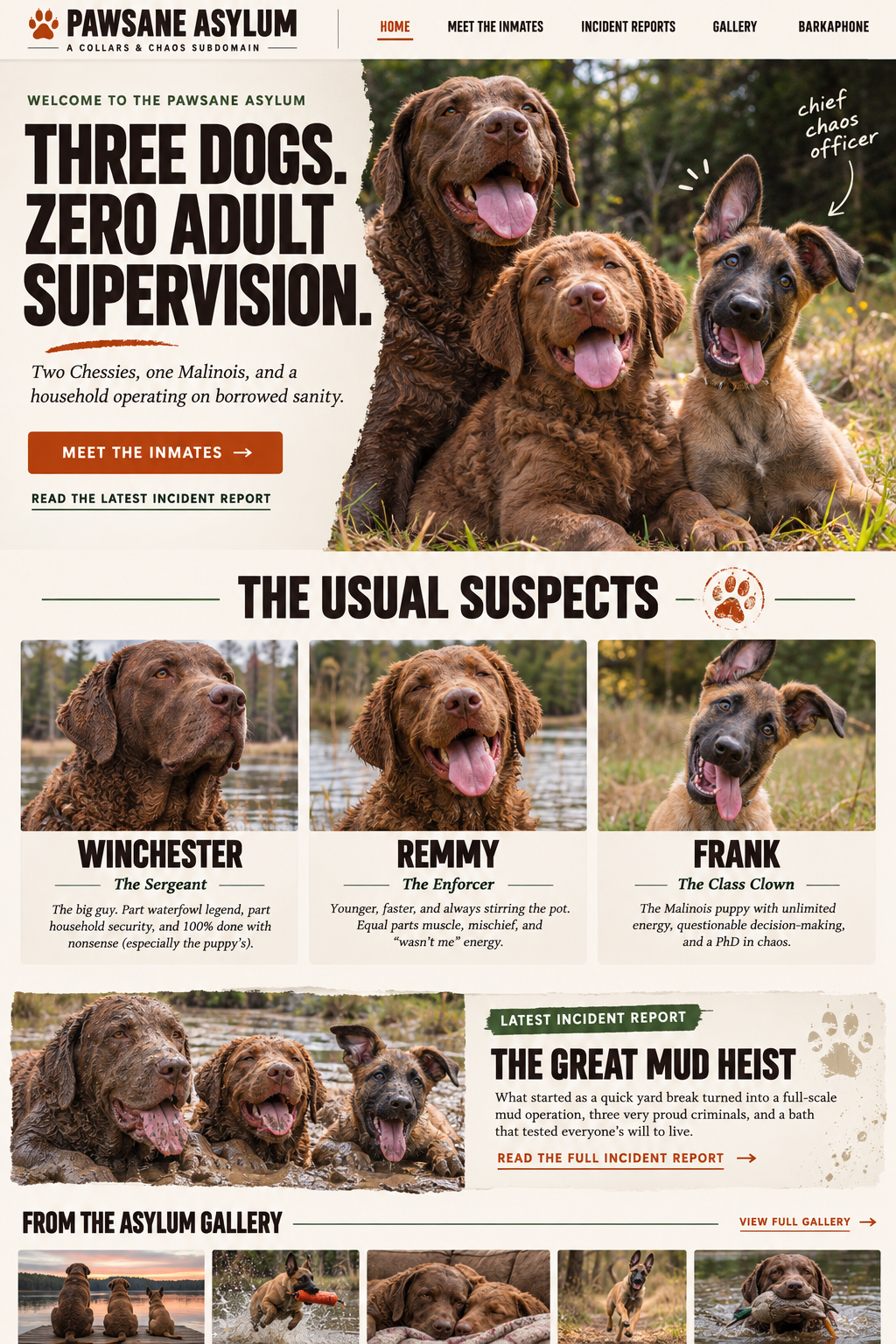
If you've spent five minutes looking around Pawsane Asylum, you've probably figured out that we have three dogs with three very different personalities.
Winchester, our resident sergeant.
Remmy, who seems convinced every situation would benefit from a little more excitement.
And Lil Frank, a Belgian Malinois puppy who is currently investigating whether every object in the house can be turned into a toy.
They're funny. They're beautiful. They're intelligent.
And they can be an absolute pain in the ass.
But behind the photographs, ridiculous incident reports, and ongoing investigations into missing household property, there's something we take very seriously.
The responsibility of giving these dogs the lives they deserve.
That's why we train.
STRUCTURE. PLAY. TRUST.
I believe a dog needs more than food, a comfortable bed, and somebody to scratch his ears.
Especially a working dog.
These animals were developed over generations for intelligence, athleticism, drive, and the ability to work alongside people.
That doesn't mean every German Shepherd needs to become a police dog or every Chesapeake Bay Retriever needs to compete in hunting trials.
It means recognizing what these dogs are capable of and giving them meaningful ways to use their minds and bodies.
For us, that starts with structure.
Not endless rules for the sake of rules.
Not turning the house into a military installation.
Structure means our dogs understand what we expect, what they can count on, and how to succeed.
They learn that waiting calmly gets them through a doorway.
That paying attention earns a reward.
That coming when called matters.
That there's a time to play like complete lunatics and a time to settle down.
And that the people they live with are consistent.
Structure gives them something to count on.
Then there's play.
Good God, do I believe in play.
My German Shepherd Roscoe was absolutely obsessed with frisbees.
We played every day for years.
But even those ridiculous, high-energy frisbee sessions became opportunities to communicate, practice self-control, and strengthen our relationship.
We weren't simply exercising.
We were doing something together.
And that's the part I love most.
Back to sections ↑IT STARTS WITH LOOK AT ME
One of the most important exercises my trainer Mary ever taught me was called Look at Me.
And it wasn't simply holding up a treat and hoping the dog glanced in my direction.
We used his actual meals.
I'd take a handful of food and hold it directly in front of Roscoe's nose.
Then I'd move my hand around, sometimes excitedly, making that food awfully tempting.
Remember, this was a dog who wanted to eat.
But he wasn't allowed to grab the food.
I'd tell him:
"Leave it."
And the rules were simple.
He had to remain sitting directly in front of me.
He couldn't grab the food.
He couldn't break his sit.
And he had to look away from the food and make eye contact with me.
Not just a quick glance.
He had to hold that eye contact.
I'd wait.
And when he was sitting calmly, looking directly into my eyes instead of at the food, I'd finally give him permission.
"You may eat."
Then he got his reward.
And we'd do it again.
And again.
Breakfast and dinner.
Every day.
For four months.
Think about what that little exercise meant to our relationship.
Roscoe was learning that he didn't have to immediately act on every impulse.
He could want something badly and still wait.
He could be excited and still pay attention.
He could look to me for guidance.
And I was learning something, too.
How to be patient.
How to communicate clearly.
How to recognize when he was giving me his attention.
And how to make that moment worthwhile for him.
As he improved, we gradually built his ability to maintain that focus.
That same attention eventually became part of everything we did together.
Obedience.
Heeling.
Recall.
Even those ridiculous frisbee sessions where he'd sit practically vibrating while I threw his favorite disc, waiting for permission to explode across the field.
It all started with those little moments.
A handful of food.
A dog sitting in front of me.
And two eyes looking into mine.
Look at Me.
That was the exercise Mary taught us. It's a personal example of our training, not a claim that every dog should be taught in exactly the same way.
But it taught me something I've never forgotten.
Great relationships are built through thousands of small interactions.
Back to sections ↑THE ORDINARY TUESDAY EVENING
Here's something you don't see much in impressive working-dog videos.
The ordinary Tuesday evening.
You're tired.
You've had a long day.
You'd love to sit down, crack open a beer, and watch television.
Meanwhile, your Malinois puppy has discovered a grill scraper.
Again.
You tell him to leave it.
He does.
An hour later, he apparently decides the previous ruling is open to appeal.
Welcome to puppy ownership.
Now, I can laugh about that.
Hell, I think it's hilarious.
But I also understand that Frank is a baby.
He doesn't arrive knowing the rules.
And he isn't going to learn them because I explained something once and expected him to remember it forever.
He needs repetition.
Guidance.
Patience.
And opportunities to succeed.
There are evenings when I spend hours on the porch simply watching him, interacting with him, and working on the little things.
Not every minute is a formal training session.
Sometimes we're playing.
Sometimes we're practicing a command.
Sometimes I'm rewarding a good choice.
Sometimes I'm realizing I expected too much from a puppy and need to take a step back.
That's part of the work, too.
The commitment isn't just showing up when training is fun. It's showing up when it's ordinary.
And over time, those ordinary moments become something extraordinary.
Back to sections ↑EVERY DOG IS DIFFERENT
I want to make something very clear.
I'm not a professional dog trainer.
I don't have a wall full of certifications.
I don't run obedience classes, and I'm not interested in telling strangers that I know the one correct way to train every dog.
I trained one German Shepherd named Roscoe who became an extraordinary dog.
I'm proud as hell of that.
But I had help.
A tremendous amount of help.
Mary spent months teaching me how to communicate with Roscoe.
And she probably corrected me more times than she corrected him.
My tone of voice.
My timing.
The way I handled the leash.
My body language.
My consistency.
She used to tell me that dogs were the easy part.
Humans were the hard part.
She wasn't wrong.
Now I have Frank.
And I know something I didn't know when I brought Roscoe home.
Frank isn't Roscoe.
He has his own personality, abilities, challenges, and pace.
And he deserves to be treated as an individual.
I also spend time working with our Chesapeake Bay Retrievers, Winchester and Remmy.
They're intelligent dogs with tremendous ability.
But their personalities and motivations aren't identical to Roscoe's or Frank's.
Something that works beautifully with one dog might not work nearly as well with another.
That's why I believe in paying attention to the dog in front of you.
Not the dog you wish you had.
Not the dog somebody showed you on YouTube.
The one standing right there, looking at you.
Back to sections ↑TRAINING TOOLS AREN'T A RELIGION
There are few subjects in the dog world that generate more arguments than training methods and equipment.
E-collars.
Prong collars.
Treats.
Corrections.
Rewards.
Everybody seems to have an opinion.
And some people are awfully certain that their way is the only way.
I'm not interested in joining another internet shouting match.
I've seen how differently individual dogs respond to training.
I believe rewards, praise, consistency, and building trust are fundamental.
I also have personal experience with training tools that people have strong opinions about.
But I'm not going to tell anyone that a particular collar is necessary for their dog, or that something appropriate for one dog is automatically appropriate for another.
Age, temperament, behavior, timing, welfare, and the handler's experience all matter.
Some training decisions deserve professional guidance.
I've benefited enormously from that guidance myself.
What I care about is the dog.
His confidence.
His well-being.
His ability to understand what's expected.
And the relationship we're building.
The goal isn't to prove a training philosophy right. It's to do right by the dog.
Back to sections ↑BEFORE YOU BRING ONE HOME
If you're thinking about getting a Belgian Malinois or German Shepherd because you've watched videos of them performing incredible obedience routines, I understand.
They're magnificent animals.
Watching a beautifully trained working dog is something special.
But here's what I'd ask you to consider.
Are you interested in the dog?
Or are you interested in what the finished product looks like?
Because those are two very different things.
That incredible off-leash heel didn't happen by magic.
Neither did the recall.
Or the self-control.
Or the focus.
Somebody put in the time.
And not just for a few weeks.
For months.
For years.
And the work doesn't stop when the dog learns the commands.
The relationship continues.
The dog still needs exercise, mental stimulation, companionship, and meaningful activity.
There will be setbacks.
There will be frustrating days.
There will be times when you wonder whether you're making any progress at all.
And there will probably be a few household objects that don't survive the experience.
If that sounds miserable to you, think seriously about whether a high-drive working breed fits your life.
There's absolutely nothing wrong with wanting a dog whose needs better match your lifestyle.
In fact, recognizing that before bringing a dog home is a responsible decision.
But if you read all that and think it sounds exciting?
If the idea of spending your evenings working with your dog sounds like something you'd genuinely enjoy?
If you're willing to learn, make mistakes, seek help, and invest the time?
Then you might understand exactly why I love this so much.
Just remember:
Back to sections ↑Don't fall in love with what a working dog can do. Make sure you're willing to love everything it takes to get there.
THE FREEDOM ON THE OTHER SIDE
One of the greatest things Roscoe and I eventually experienced was freedom.
The freedom to go places together.
To enjoy activities without constantly struggling to communicate.
To play frisbee while he waited for my release command, practically vibrating with excitement.
To walk together with an understanding that had taken years to develop.
People would sometimes watch Roscoe perform and be amazed by his obedience.
I was proud of that.
Of course I was.
But what made me happiest wasn't impressing somebody.
It was knowing what Roscoe and I had built.
That dog had started his life with me terrified of the world.
And we'd worked together until he could enjoy it.
That's the reward I remember.
Not a perfect dog.
A confident dog.
A happy dog.
A dog who understood me.
And a relationship that made both our lives better.
Back to sections ↑ONE GOOD SESSION AT A TIME
Now I'm starting again with Lil Frank.
Some days he amazes me.
Other days he reminds me that he's still a puppy with a questionable understanding of personal property.
And that's okay.
We're not in a race.
I don't need Frank to become Roscoe by next Tuesday.
I don't need him to impress anybody.
I need to give him the time, patience, structure, play, and guidance to become the best version of himself.
We'll see where his abilities take us.
Maybe advanced obedience.
Maybe dock diving.
Maybe other dog sports.
Maybe things I haven't even thought of yet.
But those accomplishments aren't the reason I'm doing this.
I'm doing it because I know what the relationship can become.
I know what those ordinary evenings can add up to.
And I know that someday, years from now, I'll look back on these early days and realize that the moments that seemed so small were actually the ones that mattered most.
The first sit.
The first reliable recall.
The first time he chooses to look at me instead of something distracting him.
The quiet moments when we're simply together.
That's what I'm building.
One day.
One session.
One little victory at a time.
Because training isn't just something we do with our dogs.
It's part of how we love them.
He wasn't just the dog I trained.
He was the dog who trained me.
Back to sections ↑